Home Sauna Electrical Requirements: Install Guide
Table of Contents
- Start With the Heater: How to Read Sauna Electrical Requirements
- Sauna Heater Voltage and Amperage: 120V vs 240V in Practice
- Sauna Dedicated Circuit Requirements: Breakers, Wire Gauge, and Panel Load
- Sauna Wiring Diagram Basics: Hardwired vs Plug-In Connections
- Sauna Electrical Code Requirements and Permits: What Your Inspector Will Check
- Outdoor, Detached Building, and Long-Run Wiring Scenarios
- Step-by-Step Installation Sequence and Common Mistakes to Avoid
- Planning Your Home Sauna Electrical Setup
- Frequently Asked Questions
Last Updated: October 12, 2026
Start With the Heater: How to Read Sauna Electrical Requirements
Sauna electrical requirements are the voltage, amperage, breaker, and wiring specs a heater needs to run safely on your home's power. Getting them right starts with one document: the heater's installation manual. The heater decides the circuit, not the other way around.
Most people shop for a sauna cabin first and think about power later. That order causes problems. A 240V heater cannot run on a standard 120V outlet, and swapping circuits after the cabin arrives means an electrician visit you did not plan for.
So read the heater label before you buy anything else.
The Five Specs That Decide Everything
Every electric sauna heater lists five numbers. Find them on the spec plate or in the manual:

- Voltage (120V or 240V)
- Wattage (total power draw)
- Amperage (current the heater pulls)
- Phase (residential heaters are single-phase)
- Circuit rating (the breaker size the maker requires)
Write these down. They drive every decision that follows.
Sauna Heater Voltage and Amperage: 120V vs 240V in Practice
Voltage and amperage work together: lower voltage means higher current for the same wattage, and higher current means thicker wire. That single relationship explains most sauna wiring decisions.
A 120V heater plugs into a standard household circuit. It works for small infrared cabins and draws more amps to make up for the lower voltage.
A 240V heater pulls roughly half the amperage for the same wattage. That lets it run on thinner wire and smaller breakers. Most traditional electric sauna heaters are 240V single-phase.

| Heater Type | Typical Voltage | Circuit Style | Best For |
|---|---|---|---|
| Small infrared cabin | 120V | Plug-in or dedicated | Apartments, tight spaces |
| Traditional electric heater | 240V | Hardwired, dedicated | Daily home sauna use |
| Large traditional heater | 240V | Hardwired, dedicated | Bigger cabins, faster heat-up |
Infrared Panels vs Traditional Heaters
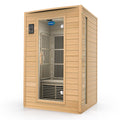
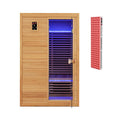
Infrared cabins spread their draw across several low-power carbon panels. A 2-person infrared model we carry runs on 120V at 1700 watts across 6 carbon heating panels, and the listing notes it needs no special wiring. Traditional heaters concentrate power in one unit. That is why a traditional heater almost always needs a dedicated 240V circuit, while many infrared cabins do not.
Sauna Dedicated Circuit Requirements: Breakers, Wire Gauge, and Panel Load
A dedicated circuit serves one appliance and nothing else. Sauna heaters need one because they draw steady, heavy current for long stretches.
The breaker size comes straight from the manual. A double-pole breaker handles 240V circuits because it switches both hot legs at once. Wire gauge follows the breaker and the run length. Longer runs need thicker copper to limit voltage drop.

A Model-Specific Sizing Workflow
Generic rules of thumb fail because every heater has different requirements. Here is a workflow for sizing a 240V heater:
Step 1: Read the nameplate. A typical 240V traditional heater rated at 6,000 watts lists these specs:
- Voltage: 240V single-phase
- Wattage: 6,000W
- Amperage: 25A (6,000 ÷ 240)
- Required circuit: 30A minimum
- Wire gauge: 10 AWG copper minimum
Step 2: Apply the 125% rule. The National Electrical Code treats sauna heaters as continuous loads because they run for extended periods. That means you multiply the amperage by 1.25.
Step 3: Check voltage drop for long runs. Voltage drop matters when the run exceeds 50 feet. A 240V circuit with 10 AWG copper wire loses roughly 3% voltage over 100 feet at 25A.
Step 4: Assess panel capacity. Add the sauna's calculated load to your existing connected load. A 200A residential service typically has existing load. Adding a sauna circuit requires assessing panel capacity.
Wire Gauge Quick Reference
| Breaker Size | Minimum Copper Wire | Typical Heater Wattage |
|---|---|---|
| 20A double-pole | 12 AWG | Up to 3,800W at 240V |
| 30A double-pole | 10 AWG | Up to 5,760W at 240V |
| 40A double-pole | 8 AWG | Up to 7,680W at 240V |
| 50A double-pole | 6 AWG | Up to 9,600W at 240V |
These are minimums for short runs. Increase gauge for runs over 50 feet or where the manual specifies.
Sauna Wiring Diagram Basics: Hardwired vs Plug-In Connections
Hardwired means the heater connects directly to house wiring, with no plug. Plug-in means the heater ends in a cord and plug that goes into an outlet.
Most 240V traditional heaters are hardwired. The connection typically includes two hot conductors, a ground, and sometimes a neutral.
Plug-in models are simpler. Many small infrared cabins use a standard 120V plug, which is why they fit apartments and rentals so well.
Homecraft Apex Electric Sauna Heater (240V/1 phase ) →
Either way, the circuit must match the heater. A plug-in heater on a shared outlet will trip that breaker the first cold evening.
Sauna Electrical Code Requirements and Permits: What Your Inspector Will Check
Local electrical code governs sauna wiring, and most areas require a permit for a new circuit. Rules vary by state and city, so confirm the specifics with your local building department before work starts. This is the step most homeowners skip, and it is the one that causes failed inspections and costly rework.
How Requirements Vary by Jurisdiction
The National Electrical Code (NEC), published by the National Fire Protection Association as NFPA 70, sets the baseline. Most jurisdictions adopt a version of the NEC, but adoption timelines and local amendments create real differences:
- Adoption lag: Some jurisdictions adopt the latest NEC edition within a year. Others remain on editions that are several cycles old. A requirement in the 2023 NEC may not apply in your area yet.
- Local amendments: Many jurisdictions add requirements beyond the NEC. Common additions include mandatory GFCI protection for certain circuits, specific disconnect requirements near the heater, and clearance rules that exceed manufacturer specs.
- Wet and damp location rules: Saunas qualify as damp or wet locations depending on the model and installation. NEC Article 680 covers pools and similar installations, but sauna-specific guidance often falls under Article 424 for fixed electric space-heating equipment.
What Inspectors Typically Check
- Breaker size and type match the heater's listing and nameplate
- Wire gauge matches the breaker rating and run length
- Grounding is continuous and bonded to the panel
- GFCI protection where local code requires it (increasingly common for 240V sauna circuits)
- Clearances between the heater and combustible surfaces match the manual
- Disconnect means within sight of the heater, if required locally
- Conduit and fittings are rated for the location (indoor, damp, or wet)
How to Verify Local Requirements
- Call your local building department. Ask whether a permit is required for a new 240V circuit and what inspections apply. Most departments answer this question in a single phone call.
- Ask which NEC edition your jurisdiction has adopted. This tells you which baseline rules apply.
- Request any local amendments in writing. Some departments publish amendments online. Others provide them on request.
- Confirm GFCI requirements. GFCI rules for sauna circuits vary. Some jurisdictions require GFCI on all 240V circuits in damp locations. Others exempt dedicated hardwired circuits. Get this in writing before your electrician starts.
- Schedule the inspection before first use. Most jurisdictions require a rough-in inspection before drywall and a final inspection after the heater is connected.
The NFPA 70 National Electrical Code sets the baseline most jurisdictions adopt, though local amendments often add requirements. The U.S. Consumer Product Safety Commission tracks home electrical hazards and publishes safety guidance worth reading before any DIY work.
For a plain-language overview of how circuits and grounding protect you, the U.S. Department of Energy electrical safety resources is a solid starting point.
Outdoor, Detached Building, and Long-Run Wiring Scenarios
Outdoor and detached saunas add two variables: distance and weather. Both change the wiring plan.
Long runs lose voltage. The farther the heater sits from the panel, the thicker the copper needs to be. A run to a detached garage or backyard cabin often needs a larger gauge than the same heater inside the house.
Outdoor wiring also needs weather-rated conduit and fittings. Buried runs need conduit rated for direct burial at the proper depth for your area.
If the detached building has its own subpanel, the sauna circuit starts there. That usually means less voltage drop and a simpler install.
Step-by-Step Installation Sequence and Common Mistakes to Avoid
Here is a recommended installation sequence:
- Confirm the heater's voltage, wattage, and required circuit from the manual.
- Check panel capacity and plan the route from panel to heater location.
- Pull the permit with your local building department.
- Run the circuit with the correct wire gauge and breaker.
- Install the heater per the manufacturer's clearances.
- Make the final connection and bond the ground.
- Schedule the inspection before first use.
- Commission the heater with a short test run and check for warm connections.
Common mistakes to avoid:
- Buying the cabin before checking panel capacity
- Using a plug-in heater on a shared circuit
- Skipping the permit to save time, then failing inspection
- Guessing wire gauge instead of matching it to the breaker
A licensed electrician handles steps 3 through 7 in most homes.
If you want a heater that pairs cleanly with a standard 240V single-phase circuit, our Homecraft Apex Electric Sauna Heater is built for exactly that setup. For tighter rooms, the slim Homecraft Revive Electric Sauna Heater fits the same circuit in a smaller footprint.
Planning Your Home Sauna Electrical Setup
The heater manual is your starting point, and the panel is your reality check. Match the two before you buy, and the install gets simple.
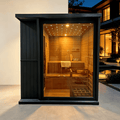
Our cedar saunas and electric heaters ship free within the Continental U.S., and our team can point you to the specs your electrician needs.
The hard part of a home sauna is not the cedar or the bench. It is the circuit behind the wall. Get the electrical plan right and everything else falls into place.
Frequently Asked Questions
Can I plug a sauna into a regular outlet?
Only small infrared saunas that run on 120V and draw within a standard branch circuit's capacity can use a regular outlet, and even then a dedicated circuit is strongly recommended. Traditional electric sauna heaters at 240V cannot plug into a standard household outlet. Check the manufacturer specifications on your heater's data plate: if it lists 240V or draws more than a typical 15-amp circuit allows, it needs a dedicated circuit and hardwired connection installed by a licensed electrician.
Does a home sauna need a dedicated circuit?
Yes, in nearly all cases. Sauna dedicated circuit requirements exist because the heater draws a large, continuous load that would overload a shared branch circuit and trip breakers repeatedly. A dedicated circuit means the sauna heater is the only load on that breaker, sized to the heater's wattage and voltage per the installation manual. This also satisfies most local code and inspection requirements, and it keeps your sauna from interfering with other appliances in the home.
How much does it cost for an electrician to hook up a sauna?
Costs vary widely by region, panel distance, and whether a new circuit or panel upgrade is needed, so get at least two local quotes before committing. Factors that raise the price include long wire runs, adding a subpanel, trenching to a detached building, and permit fees. A straightforward indoor 240V circuit near an existing panel sits at the low end; outdoor or detached-building runs sit at the high end. Ask each electrician to itemize labor, materials, and permit costs separately.
Can I install sauna wiring myself, or do I need a licensed electrician?
Most jurisdictions require a licensed electrician for new 240V circuits, panel work, and anything that needs a permit and inspection. Some areas allow homeowners to pull permits for their own property, but the work still must meet code and pass inspection. Given the amperage involved, the shock and fire risk, and the insurance implications of unpermitted work, hiring a licensed electrician is the safer and usually faster path. Use a wiring diagram from your heater's installation manual to plan the layout before anyone quotes the job.