Best Home Massage Chair for Chronic Pain: 2026 Guide
Table of Contents
- What to Look for in a Massage Chair for Chronic Pain
- Zero Gravity Massage Chair Benefits for Pain Relief
- How Long to Use a Massage Chair for Back Pain
- Massage Chair Safety Precautions and Contraindications
- Budget vs. Premium Features: What Actually Matters
- Integrating a Massage Chair with Physical Therapy
- Conclusion: Building Your At-Home Pain Relief Routine
- Frequently Asked Questions
Last Updated: September 18, 2026
What to Look for in a Massage Chair for Chronic Pain
Finding the best home massage chair for chronic pain starts with separating therapeutic equipment from novelty gadgets. The key specifications are roller type, track design, body scanning accuracy, and adjustable intensity.
Roller Types: 2D, 3D, and 4D
2D rollers move up and down and side to side across your back. They work for general relaxation but can't push deeper into tight muscle tissue.
Track Length and SL-Track Design
Track length determines how much of your body the rollers reach. A short track covers only your upper back; a long SL-track curves from your neck, down the spine, and under to your glutes and upper hamstrings.
Zero Gravity Massage Chair Benefits for Pain Relief
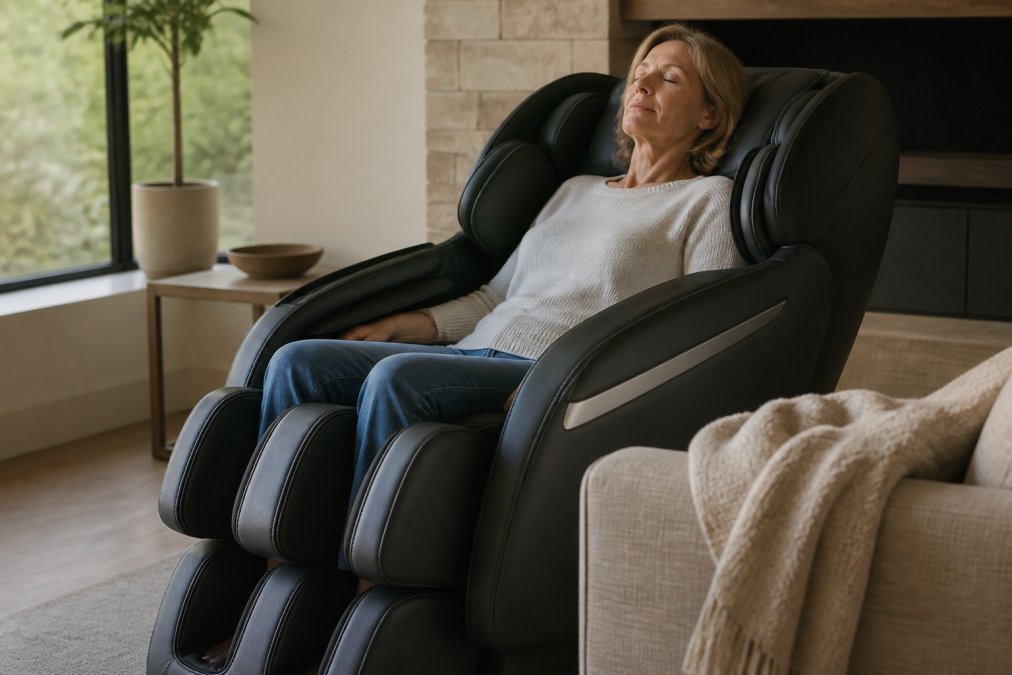
A zero gravity massage chair reclines you until your knees sit above your heart, taking pressure off the lower spine. This is the single most useful feature for chronic back pain: redistributing body weight reduces the load on your vertebrae and lets the rollers work deeper with less discomfort.
How Long to Use a Massage Chair for Back Pain
The honest answer: 15 to 20 minutes per session, once or twice a day. That's the range most manufacturers and physical therapists suggest for at-home use. Longer sessions don't multiply the benefit and can leave muscles sore, especially with deep tissue settings.
Watch for these signals that you're overdoing it:
- Lingering soreness the next day
- Numbness or tingling during the massage
- Increased stiffness instead of relief
Massage Chair Safety Precautions and Contraindications
Most buying guides treat safety as a footnote. That is a mistake. A massage chair applies real mechanical force through rollers, air compression, and heat, helpful or genuinely dangerous depending on what is causing your pain. This section matters most if you are managing a diagnosed condition.
Why the Mechanism Matters, Not Just the Diagnosis
The risk from a massage chair is not the diagnosis itself but the combination of force, heat, and vibration applied to tissue that cannot safely absorb it. Understanding the mechanism lets you judge your own situation instead of relying on a generic list.
- Mechanical pressure compresses muscle, blood vessels, and nerves. Therapeutic in healthy tissue, it can aggravate an unstable disc, healing fracture, or compressed nerve.
- Heat dilates blood vessels and increases local blood flow. That helps muscle tension but is problematic where increased circulation could dislodge a clot or where impaired sensation means you cannot feel a burn developing.
- Vibration and oscillation can loosen plaque or thrombus in vessels and can interfere with certain implanted devices.
Conditions That Require a Doctor's Clearance First
These are not automatic disqualifiers, but you should have a specific conversation with your physician or physical therapist before using a chair, and follow their guidance on intensity, duration, and body regions to avoid.
- Herniated or bulging discs. Deep roller pressure over an acutely herniated disc can increase nerve compression. Avoid direct pressure over the affected segment during a flare; use gentle, low-intensity settings between flares.
- Spinal stenosis. Narrowing of the spinal canal means less clearance for nerves. Extension positioning, including some zero gravity angles, can worsen symptoms. Test carefully and stop if you feel radiating pain.
- Sciatica and nerve compression. Pressure along an irritated nerve can intensify symptoms rather than relieve them. Target surrounding muscle, not the nerve pathway itself.
- Osteoporosis and osteopenia. Reduced bone density means reduced tolerance for mechanical force. Avoid deep-tissue and 4D settings, and aggressive air compression over the ribs and spine.
- Recent surgery, fractures, or spinal fusion. Healing tissue should not be loaded. Follow your surgeon's timeline, typically weeks to months, not days.
- Blood clotting disorders, deep vein thrombosis history, or current anticoagulant use. Mechanical pressure and heat can dislodge a clot. This is the highest-risk category; avoid a chair entirely without explicit medical clearance.
- Pacemakers and implanted electronic devices. Some chairs use electrical components and heat that can interfere with device function. Check the device manufacturer's guidance on electromagnetic interference before use.
- Peripheral neuropathy and diabetes with reduced sensation. If you cannot reliably feel pressure or heat, you cannot detect when a setting is too aggressive. Use only low settings and short sessions, and inspect your skin afterward.
- Pregnancy. Avoid in the first trimester and consult a provider before use in later trimesters. Certain acupressure points and abdominal compression are contraindicated.
- Active infection, swelling, or inflammation. Deep pressure over an infected or inflamed area can spread infection and worsen swelling.
When to Stop Immediately
Stop the session and contact a healthcare provider if you experience:
- Sharp, shooting, or radiating pain during or after the massage
- Numbness, tingling, or weakness in a limb that was not present before
- New swelling, bruising, or skin discoloration
- Dizziness, shortness of breath, or chest discomfort
- A headache during or shortly after a session
A Practical Pre-Purchase Checklist
Before you buy, work through these questions with your care team:
- What is the specific diagnosis driving my chronic pain?
- Are there regions of my back, neck, or legs that should not receive deep pressure?
- Are there positions, including reclined or zero gravity angles, that I should avoid?
- Is heat therapy safe for me given my circulation and medication profile?
- What intensity and session length do you recommend as a starting point?
Budget vs. Premium Features: What Actually Matters
Spending more gets you better mechanics, not just more buttons. But most feature tables stop at the showroom, they don't tell you how these chairs hold up after years of daily use, or whether you can get them repaired when something breaks. For a purchase in the thousands of dollars, that question should drive your decision.
The Feature Tiers, Briefly
| Feature | Budget Chairs | Mid-Range Chairs | Premium Chairs |
|---|---|---|---|
| Roller type | 2D | 3D | 4D |
| Track | Short or basic SL-track | Full SL-track | Extended SL-track |
| Body scanning | Manual presets | Basic auto-scan | Precision body scanning |
| Air compression | Few zones | Multiple zones | Full-body air compression |
| Heat therapy | None or spot | Lumbar heat therapy | Full lumbar heat therapy |
| Foot rollers | Rare | Sometimes | Reflexology foot rollers |
| Weight capacity | Lower | Standard | Higher |
What actually matters for chronic pain: 3D or 4D rollers, a full SL-track, and accurate body scanning. Everything else is comfort. A chair with 4D rollers and a long track will do more for your back than one with a dozen preset programs and weak mechanics.
The Part Nobody Talks About: Long-Term Durability
A massage chair is a mechanical device with moving parts under load. The components that fail first are predictable, and knowing them helps you evaluate any chair before you buy.
Common failure points, in rough order of frequency:
- Roller carriage and track. The carriage rides the track thousands of times. Cheaper plastic guides wear and develop a grinding or skipping feel; better chairs use metal guides and reinforced rails. This is the most expensive repair on most chairs.
- Air compression bladders and valves. Bladders leak at seams and valve connections, and one leak can disable an entire zone. Replacements are usually available, but labor to access them can exceed the part cost.
- Motors and actuators. Recline motors, leg-rest actuators, and roller drive motors are the second most common failure. Heat buildup under daily use shortens motor life, so respect duty-cycle cool-down limits.
- Control boards and wiring. Electronics fail from heat, humidity, and power surges. A surge protector is cheap insurance; board replacement is often the difference between a repair and a write-off.
- Upholstery and foam. Synthetic leather cracks at stress points, especially where the leg rest folds, and foam compresses and loses support. Neither is usually covered after the first year.
Repairability: The Question to Ask Before You Buy
Before you commit, get answers to these five questions from the seller or manufacturer:
- Is there a published parts list? If you cannot find replacement rollers, bladders, or motors listed for sale, assume the chair is disposable.
- What is the warranty, and what does it actually cover? Look for separate coverage on the frame, mechanical components, and labor. A three-year parts warranty with no labor coverage still leaves you paying for the expensive part of the repair.
- Who performs the repair? In-home service is far more valuable than ship-it-back service on a chair weighing well over 200 pounds.
- How long has the model been in production? A multi-year production run is more likely to have parts available than a one-year model already replaced.
- What is the expected service life? Manufacturers who will not state a number are telling you something. A well-built chair under daily use should last several years before major service, longer with lighter use and proper cool-down.
A Note on Extended Warranties
Extended warranties are worth evaluating on mechanical components, not electronics. A warranty covering roller carriage, motor, and actuator replacement with in-home labor can pay for itself with a single repair. Read exclusions carefully: wear items like upholstery and foam are almost always excluded, as are failures from power surges or exceeding the duty cycle.
Matching Budget to Your Actual Needs
Skip premium features you will not use. If you never want a foot massage, don't pay for reflexology foot rollers, put that budget toward better rollers, a longer track, and a stronger warranty. For chronic pain management, the priorities in order are:
- 3D or 4D rollers with adjustable depth
- Full SL-track length
- Accurate body scanning and zone control
- A warranty that covers mechanical parts and labor
- Heat therapy, if it is safe for your condition
Integrating a Massage Chair with Physical Therapy
A massage chair works best as a complement to your physical therapy plan, not a replacement. Your therapist builds strength, mobility, and correct movement patterns; the chair relaxes muscle tissue, improves circulation, and reduces stiffness between sessions so you can do the work.
Here's how to fit it into a real routine:
- Before therapy exercises: 10 minutes on a low setting to warm up tight muscles
- After therapy exercises: 15 minutes to ease soreness and support muscle recovery
- On rest days: a full session to manage chronic pain and keep stiffness down
Conclusion: Building Your At-Home Pain Relief Routine
Chronic pain doesn't take days off, and neither should your access to relief. A consistent at-home routine built around a well-chosen massage chair gives you a recovery tool ready when you are, without appointments or travel. Cedar Forge Wellness offers massage chairs designed for exactly this purpose, alongside a curated range of home wellness equipment built for daily restoration.
Frequently Asked Questions
What type of massage is best for chronic pain?
Deep tissue and trigger point therapy work best for chronic pain because they target specific tension zones and muscle knots. Shiatsu and 4D roller settings mimic these techniques by applying firm, circular pressure. Look for a chair with adjustable intensity levels and body scanning technology so the rollers adapt to your frame. Lumbar heat therapy and air compression add circulatory improvement, which helps reduce stiffness between sessions.
How often should you use a massage chair for chronic pain?
Most people benefit from 15 to 30 minutes once or twice daily. Start with one 15-minute session and increase gradually. A chair with zero gravity positioning and adjustable intensity lets you control pressure, so you avoid overworking sore muscles. If pain flares, reduce session length rather than stopping entirely. Consistency matters more than duration for chronic pain management.
Are massage chairs good for arthritis pain?
Massage chairs can ease arthritis discomfort by improving circulation and reducing muscle stiffness around affected joints. Heat therapy and gentle air compression are especially helpful. However, avoid deep 4D roller settings directly on inflamed joints. Talk to your doctor before use, especially if you have rheumatoid arthritis or recent joint surgery, since massage chair safety precautions vary by condition.
What are the downsides of using a massage chair?
Overuse can cause soreness or bruising, especially on high intensity settings. Some people with herniated discs, recent fractures, or circulatory conditions should not use them without medical clearance. High-ticket chairs also need floor space and occasional servicing. Weigh these against the convenience of at-home wellness and the cost of regular professional sessions.