Best Sauna for Small Home Spaces: 2026 Buyer's Guide
Table of Contents
- Quick Comparison: Best Saunas for Small Home Spaces
- Infrared Sauna vs Traditional Sauna for Home Use
- 1-Person Sauna Dimensions: What Actually Fits
- Home Sauna Electrical Requirements: 120V vs 240V
- Materials and Build Quality: Cedar, Hemlock, and More
- Apartment and Condo Constraints: Ventilation, Noise, and Power
- Long-Term Cost of Ownership: What to Budget Beyond the Purchase
- Conclusion
- Frequently Asked Questions
Last Updated: September 16, 2026
Quick Comparison: Best Saunas for Small Home Spaces
Choosing the best sauna for small home spaces comes down to three variables: footprint, power supply, and how the unit handles heat retention in a tight room.
The table below summarizes what actually separates a workable compact sauna from an expensive mistake.
| Priority | What to Check | Why It Decides the Purchase |
|---|---|---|
| Room size | Footprint dimensions vs. clearance | A sauna needs air gap on all sides |
| Power | 120V plug-in vs. 240V hardwire | Determines whether you need an electrician |
| Build | Cedar, hemlock, or redwood | Affects heat retention and lifespan |
| Ventilation | Vent placement and humidity control | Prevents moisture damage in small rooms |
| Seating | Ergonomic seating and bench depth | One-person units live or die on comfort |
Below, we break down each factor so you can shortlist with confidence rather than guesswork.
U.S. Department of Energy residential electrical guidance
Infrared Sauna vs Traditional Sauna for Home Use
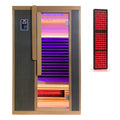
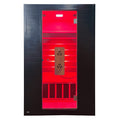
Infrared saunas heat your body directly with radiant panels, while traditional saunas heat the air around you with a stove and sauna stones. That single difference explains nearly every trade-off that follows.
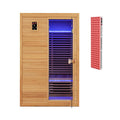
For small spaces, infrared usually wins. It reaches temperature faster, runs on lower power, and doesn't need the ceiling height a traditional cabin demands. Full-spectrum infrared units add near-infrared and far-infrared wavelengths, which some users prefer for a broader thermal therapy experience.
Traditional saunas still have a place. If you want the ritual of pouring water over hot stones and controlling humidity, a compact traditional unit delivers that. The catch is power draw and heat-up time.
A common mistake is buying traditional for a small room without checking clearance. Stoves need breathing room, and tight installations overheat.
1-Person Sauna Dimensions: What Actually Fits
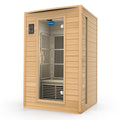
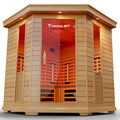
A one-person sauna typically occupies a compact footprint roughly the size of a large wardrobe, often around 90 to 120 centimeters square, with interior bench depth designed for a single seated user. Measure your intended corner before anything else.
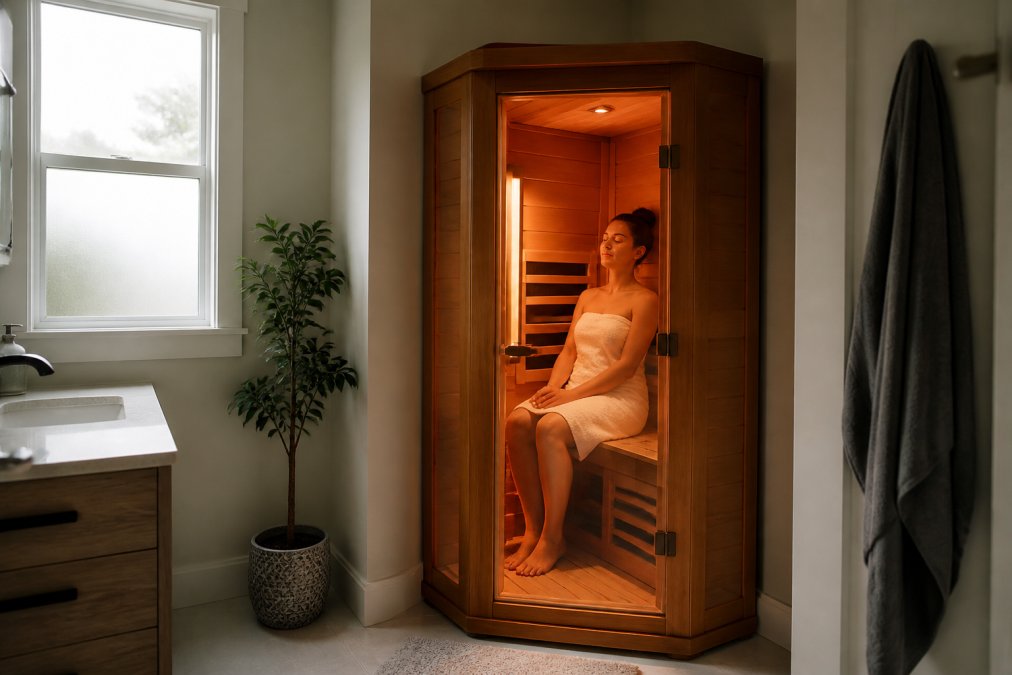
Three measurements matter more than the marketing spec sheet:
- Exterior footprint: the wall-to-wall space the unit consumes
- Interior bench depth: how far your back sits from the heater
- Clearance: the gap you must leave for ventilation and door swing
What most guides miss is the door swing. A unit that fits perfectly on paper can still block a bathroom doorway once the tempered glass door opens. Sketch the arc on the floor with tape before you commit.
Home Sauna Electrical Requirements: 120V vs 240V
The best sauna for small home spaces is often the one your electrical panel can actually support. Most compact infrared units run on a standard 120V plug-in circuit, while larger infrared cabins and nearly all traditional saunas require a dedicated 240V line installed by a licensed electrician. The difference is not cosmetic, it decides whether you unbox and plug in, or schedule a permit and a contractor.
Here is the practical split, with the numbers that actually matter:
- 120V plug-in: draws roughly 1,200-1,800 watts, which is about 10-15 amps. On a standard 15-amp household circuit, that leaves almost no headroom for anything else on the same line. On a 20-amp circuit, it fits with a small margin. Best for one-person infrared units.
- 240V hardwire: draws roughly 3,000-6,000 watts (about 13-25 amps at 240V), which is why it needs its own double-pole breaker and a dedicated run. Required for most traditional stoves and larger infrared cabins.
Why the amperage math matters more than the voltage label. A 120V sauna that pulls 15 amps on a 15-amp breaker will nuisance-trip the moment a refrigerator or space heater shares the circuit. The fix is not a bigger breaker, it is a dedicated circuit. Most electricians will run a new 120V dedicated line for a small infrared unit at a fraction of the cost of a 240V run, which is one reason infrared dominates small-space installs.
What to check before you buy:
- Open your panel and identify the amperage of the breaker feeding the outlet you intend to use (15A vs 20A is stamped on the switch).
- Confirm whether that circuit is shared with kitchen, laundry, or bathroom receptacles, if it is, assume it is not usable for a sauna.
- Count spare breaker slots. A 240V sauna needs two adjacent slots; if your panel is full, a subpanel or service upgrade may be required.
- Verify the unit's nameplate wattage and divide by voltage to get real amperage, then leave at least 20% headroom on the breaker.
Check local code requirements with your municipal building department, since permit and inspection rules vary by jurisdiction. Hardwired 240V installations almost always require a permit and a licensed electrician; plug-in 120V units generally do not, but a dedicated circuit still may.
U.S. Department of Energy residential electrical guidance
Materials and Build Quality: Cedar, Hemlock, and More
Cedar wood remains the benchmark for sauna construction because it resists moisture, stays cool to the touch, and holds heat without warping. Hemlock is the budget-friendly alternative, lighter and less aromatic but serviceable. Redwood sits at the top tier for durability and appearance.
Material choice affects more than looks.
Apartment and Condo Constraints: Ventilation, Noise, and Power
Most sauna guides assume a house with a spare room, a full panel, and no downstairs neighbor. That is not the reality for a large share of small-space buyers. Apartment and condo installations run into three constraints that house owners never face: moisture management in a sealed room, vibration and noise transfer through shared walls and floors, and electrical capacity you do not control.
- Set the unit on a dense rubber or cork vibration mat rather than directly on the floor.
- Add rubber feet or isolation pads under the base if the manufacturer allows it.
- Avoid mounting the sauna against a shared wall if you have any alternative; an interior wall shared with your own hallway or closet is better.
- Choose infrared over traditional where noise is a concern, infrared panels are silent, while stoves and stones crackle and pop.
Long-Term Cost of Ownership: What to Budget Beyond the Purchase
The purchase price is the smallest part of the equation. Long-term cost of ownership includes power consumption, replacement parts, and maintenance over the life of the unit.
Budget for these recurring items:
| Cost Category | What Drives It | How to Control It |
|---|---|---|
| Power consumption | Heating element wattage and session length | Choose infrared, run shorter sessions |
| Replacement parts | Heating elements, control panels | Buy units with serviceable components |
| Maintenance | Wood conditioning, ventilation checks | Inspect quarterly, clean vents |
| Repairs | Out-of-warranty failures | Ask about parts availability before buying |
Conclusion
Matching a sauna to a small space is a measurement problem before it's a wellness decision. Get the footprint, the circuit, and the ventilation right, and everything else falls into place.
Frequently Asked Questions
What is the best small sauna for home use?
The best small home sauna depends on your space and electrical setup. Infrared models with a compact footprint are often ideal for tight rooms because they plug into a standard 120V outlet and heat up in minutes. Traditional saunas need more clearance and a dedicated 240V circuit. Measure your available floor space, check your electrical panel, and prioritize a unit that fits without blocking doors or vents.
How much space do I need for a 1-person home sauna?
A 1-person sauna typically needs a floor area of roughly 3 by 3 feet to 4 by 4 feet, with at least 6 feet of interior height. You also need clearance for the door to open fully and a few inches around the unit for ventilation. Corner placement can save space. Always check the exact footprint dimensions listed for the model you are considering before purchase.
Are infrared saunas better for small apartments than traditional saunas?
Infrared saunas are often better for apartments because many run on a standard 120V plug-in outlet and produce less ambient heat. Traditional saunas usually require a 240V dedicated circuit and more ventilation. If your building has strict electrical or noise rules, an infrared model with low EMF levels and a compact footprint is usually the more practical choice. Always confirm your lease terms before installing.
What is the 200 rule for saunas?
The 200 rule is a general guideline suggesting you should not exceed 200 degrees Fahrenheit in a traditional sauna. Most traditional saunas operate between 150 and 195 degrees Fahrenheit. Infrared saunas operate at lower temperatures, typically 120 to 150 degrees Fahrenheit. Always follow the manufacturer's recommended temperature range and consult a doctor if you have cardiovascular concerns or chronic health conditions.
The challenge with small-space saunas isn't finding one that fits. It's finding one that fits, heats properly, and lasts without forcing a renovation. Cedar Forge Wellness offers compact cedar saunas built for tight rooms, with genuine cedar construction, plug-in-friendly designs, and quick heat-up times that make daily use realistic. Explore the collection and create a home wellness space that works within your walls.