Sun Valley Saunas Alternative: 5 Cedar Saunas to Try
Table of Contents
- Why Homeowners Look for a Sun Valley Saunas Alternative
- Quick Comparison: 5 Cedar Saunas at a Glance
- How to Choose a Home Sauna: 6 Specs That Decide It
- Infrared vs Traditional Sauna Benefits: Which Heat Suits You?
- 1. Blisspod Venetian: Best Value Full-Spectrum Infrared
- 2. AuroraTherm Cedar: Best Compact Traditional Sauna
- 3. Solstice Elite Horizon: Best Mid-Range for 4-5 People
- 4. LumenStone Auro 3: Best for Design-Led Interiors
- The Two Things Most Sauna Guides Skip
- Frequently Asked Questions
Last Updated: October 4, 2026
Why Homeowners Look for a Sun Valley Saunas Alternative
Shoppers searching for a Sun Valley Saunas alternative aren't chasing a trend, they want a sauna that fits a real room, runs on a real circuit, and still works five winters from now. That's the standard this guide from Cedar Forge Wellness holds every option to.
Most sauna listings sell heat and hide logistics. They show a glowing cedar box and skip the amperage draw, ceiling height, warranty terms, and what happens when a heater fails in year six, the details that decide whether a sauna becomes a daily ritual or an expensive storage closet.
Below, we compare five cedar saunas we sell, explain the six specifications that determine whether a unit belongs in your home, and cover two angles most buying guides skip: long-term ownership cost and site preparation.
One thing up front: a sauna is a fixed installation, not an appliance you swap out on a whim. Buy the wrong one and you live with it.
Quick Comparison: 5 Cedar Saunas at a Glance
The short version: every unit below is an indoor model with a glass front, an electric heater, and a wood structure warranty of at least seven years.
| Model | Price | Heat Type | Capacity | Heater | Wood Warranty |
|---|---|---|---|---|---|
| Blisspod Venetian | $4,999 | Full-spectrum infrared | 3 | 11 heaters, 220V | Not listed |
| AuroraTherm Cedar | $6,495 | Traditional electric | 2-3 | 6.5 kW | 7 years |
| Solstice Elite Horizon | $8,250 | Traditional electric | 4-5 | 9 kW | 10 years |
| LumenStone Auro 3 | $8,990 | Traditional electric | 3-4 | 7.5 kW | 8 years |
| Vantaa Eclipse Luxe | $9,450 | Traditional electric, steam-ready | 4-6 | 9 kW | 10 years |
The spread here is roughly $4,500, and it isn't random, the gap tracks heater output, capacity, and enclosure engineering.

How to Choose a Home Sauna: 6 Specs That Decide It
Choosing a home sauna comes down to six specifications: electrical requirements, footprint, capacity, heater type, wood species, and warranty terms. Get those right and the aesthetic questions become easy. Get them wrong and no amount of backlighting saves you.
Here's how we'd work through them, in order.
Electrical Requirements and Voltage
Most full-size electric saunas need a dedicated 220-240V circuit, verify that before you fall in love with a model. A 6.5 kW heater, like the AuroraTherm Cedar's, draws far more current than a 120V household outlet can supply.
Check three things:
- Panel capacity. Does your electrical panel have room for another double-pole breaker?
- Run distance. A long cable run from panel to sauna may require heavier gauge wire.
- Local code. Sauna circuits typically need GFCI protection and a disconnect within sight of the unit.
The Blisspod Venetian is rated at 3080W, 220V, and 14A. Budget for an electrician's visit as part of the purchase, not an afterthought.

Footprint, Capacity, and Site Preparation
Site preparation is where most buyers underplan. Measure the room twice, with door swing and clearance in mind.
The AuroraTherm Cedar runs 210 cm long by 120 cm wide, the narrowest option here and a good fit for a spare bedroom corner. The Vantaa Eclipse Luxe stretches to 190 cm wide for 4-6 people, a different room entirely.
Two structural questions matter:
- Floor loading. A sauna with heater and occupants is heavy. Concrete slabs handle it easily; upper floors in older homes deserve a second look.
- Ventilation. Indoor saunas need airflow to manage humidity. A nearby window or a mechanical vent helps.
Climate matters too. Humid regions demand more attention to ventilation and moisture management, while cold climates favor an indoor unit that sidesteps the freeze-thaw stress outdoor cabins face.
Infrared vs Traditional Sauna Benefits: Which Heat Suits You?
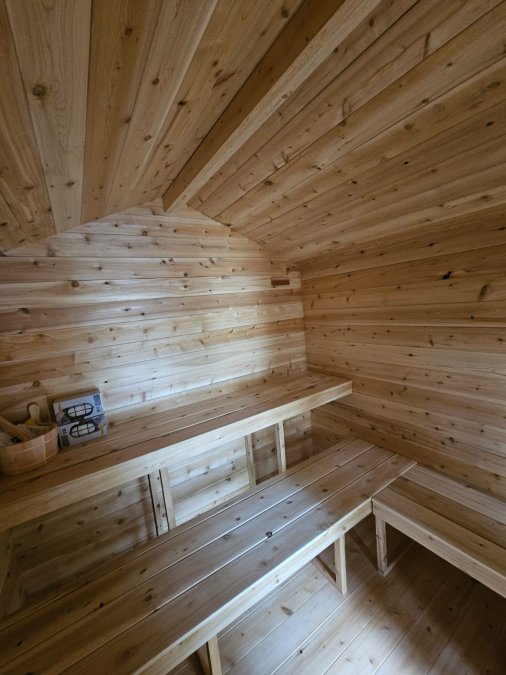
Infrared saunas heat your body directly with radiant panels; traditional saunas heat the air with a stove and stones. The infrared versus traditional sauna benefits question comes down to what you want from a session.
Traditional heat, dry or humid depending on whether you add water to the stones, produces the classic intense sweat at higher temperatures. Infrared runs cooler and gentler, which some prefer for longer sessions.
A few practical differences:
- Warm-up time. Infrared panels reach temperature faster. Traditional heaters need time to heat the room and the stones.
- Experience. Traditional saunas support löyly, the steam burst from pouring water on hot stones. Infrared doesn't.
- Footprint. Infrared units often run on lower wattage and fit tighter spaces.
The Blisspod Venetian covers the full infrared spectrum, near, mid, and far, with 11 heaters including carbon panels on the sides and floor. For the traditional ritual with a bucket and ladle, the Solstice Elite Horizon, LumenStone Auro 3, and Vantaa Eclipse Luxe all ship steam-ready.
Neither type is objectively better. Pick the heat that matches how you'll actually use the room.
1. Blisspod Venetian: Best Value Full-Spectrum Infrared
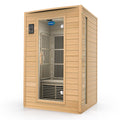
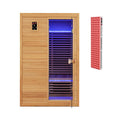
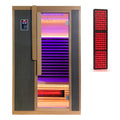
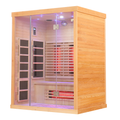
The Blisspod Venetian is the lowest-priced sauna here at $4,999 and the only infrared model. For buyers who want full-spectrum infrared without a five-figure commitment, it's the obvious starting point.
Full spectrum means near, mid, and far infrared: near is absorbed just below the skin, mid reaches deeper into soft tissue, and far penetrates fat cells to drive vasodilation.
The extras are useful rather than decorative: chromotherapy lighting, an infrared foot heater for reflexology, an oxygen ionizer that filters dust and pollen, and two preinstalled speakers.
Where it falls short: the 3080W/14A draw still requires a dedicated 220V circuit, and it caps at 140°F, cooler than a traditional sauna. If you want intense dry heat, this isn't it.
Indoor Cedar Sauna Designed for Premium Home Wellness, Canadian Red Cedar →
2. AuroraTherm Cedar: Best Compact Traditional Sauna
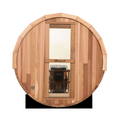
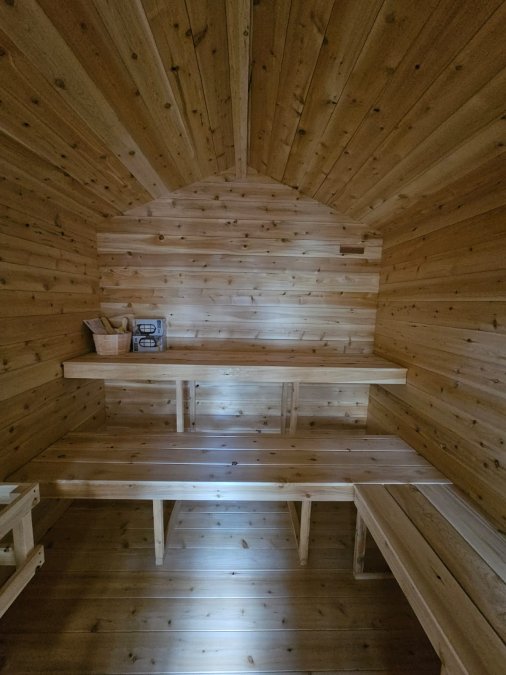
Compact spaces have a clear winner. The AuroraTherm Cedar is 120 cm wide, the narrowest unit here, and built from solid Canadian red cedar, naturally resistant to moisture and decay, with a warm aroma most hemlock and aspen builds can't match.
At $6,495, you get a 6.5 kW electric heater with digital controls, two-tier ergonomic cedar benches, and a frameless tempered glass door. Capacity is 2-3 people, a couple or a solo daily ritual.
The cedar is the headline: it's the only red cedar model here, and cedar's natural oils are why it holds up so well in a wet, hot environment.
The trade-off is size. With a 6.5 kW heater and a 2-3 person rating, this is not the sauna for a family of five. It's also the tallest unit here at 230 cm, so verify ceiling height before ordering.
Warranty is 7 years on the wood structure and 3 years on electrical components, the shortest electrical coverage in this group.
3. Solstice Elite Horizon: Best Mid-Range for 4-5 People
If you need to seat four or five without jumping to the top of the price range, the Solstice Elite Horizon at $8,250 is our pick, pairing premium Canadian hemlock with a 9 kW heater and rapid heat-up technology.
The 9 kW heater matches the Vantaa Eclipse Luxe, which costs $1,200 more, the value case right there: equal heater power at a lower price, seating 4-5 instead of 4-6.

What you give up is mostly aesthetic. The Vantaa uses thermo-treated alder with espresso framing and a touchscreen; the Solstice uses hemlock with horizontal slat benches and a star-panel LED ceiling. Both are steam-ready with a bucket and ladle included.
Warranty is strong: 10 years on the wood structure and 5 years on heater and electronics, matching the Vantaa's coverage.
The honest limitation: hemlock lacks cedar's aromatic oils and decay resistance. It's solid and heat-retentive.
4. LumenStone Auro 3: Best for Design-Led Interiors
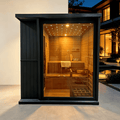
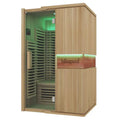
Design-forward buyers should look at the LumenStone Auro 3. At $8,990, it's the most architectural unit here, hand-finished in pale Nordic aspen with a backlit stone accent wall and concealed perimeter LEDs.
The 7.5 kW stainless tower heater is water-ready, so you can add löyly with the included bucket and ladle. Capacity is 3-4 people on two-tier floating benches with a corner step.
It earns its price in details you notice daily: hidden fasteners, slatted benches, and a full-height frameless glass front with a long stainless handle. It reads as furniture rather than equipment, which matters if the sauna shares a wall with a living space.
Two caveats: aspen is softer than cedar or hemlock, and the 7.5 kW heater is the second-lowest output among the traditional models, so heat-up is slower than the 9 kW units.
Warranty sits in the middle at 8 years on wood and 4 years on electronics.
The Two Things Most Sauna Guides Skip
Two ownership realities separate a good purchase from a regretful one: ten-year cost and assembly difficulty.
On long-term cost, the purchase price is only the entry fee. Add the electrician, dedicated circuit, and any floor reinforcement, then ongoing costs: heater stones, gaskets, and electricity.
On assembly, none of these are flat-pack furniture. They arrive as modular panel kits on a pallet in several boxes and require two people and most of a day. The Blisspod Venetian ships in four boxes and uses a quick-assembly system; the traditional units with heaters and stone compartments involve more steps and benefit from professional installation.
Shipping logistics matter too. All five ship free within the Continental U.S., but confirm driveway access and whether delivery is curbside or inside placement before the truck arrives.
Frequently Asked Questions
What are the most reliable alternatives to Sun Valley Saunas?
Look at brands that publish full specifications, warranty terms, and electrical requirements before you buy. Cedar Forge Wellness lists all three for every unit: the AuroraTherm Cedar Indoor Sauna carries a 7-year wood and 3-year electrical warranty, while the Vantaa Eclipse Luxe and Solstice Elite Horizon both carry 10-year wood and 5-year electrical coverage. Published specs and clear warranty terms are the two signals that separate a reliable seller from a drop-shipper.
What features should I look for when comparing home sauna brands?
Check five things: heater type and kilowatt rating, wood species, capacity, voltage and amperage, and warranty length. The AuroraTherm Cedar Indoor Sauna uses a 6.5 kW electric heater in a 210 cm x 120 cm footprint for 2-3 people. The Vantaa Eclipse Luxe runs a 9 kW Finnish heater for 4-6 people. Higher kilowatts mean faster heat-up but also a larger circuit, so match the heater to your panel before you match it to your bathroom.
What is the difference between infrared and traditional cedar saunas?
Traditional saunas heat the air and the room, so you sit in dry or humid heat and can add steam with a bucket and ladle. Infrared saunas heat your body directly with carbon panel and full-spectrum heaters, so the air stays cooler. The Blisspod Venetian is a full-spectrum infrared unit with 11 heaters and a 140F ceiling. Traditional units like the LumenStone Auro 3 reach higher air temperatures and include a steam bucket for authentic löyly.
Is it better to buy a pre-fab sauna or a custom-built unit?
Pre-built and modular units ship assembled or in panels and typically install in a day or two with basic tools, which suits finished interiors where you do not want demolition. Custom builds let you match exact dimensions but add weeks of construction and a contractor bill. The Blisspod Venetian ships in four boxes on a pallet and uses a quick assembly system, so it is the practical pick if you want a sauna running this month rather than next season.
How do I evaluate the build quality of a home sauna?
Start with the wood. Canadian red cedar and Canadian hemlock both resist moisture and decay, and both appear across the units here. Then check the heater brand and kilowatt rating, the glass thickness, and the control panel. Thin glass, vague heater specs, and no listed certifications are the warning signs that a sauna is built to a price rather than a standard.